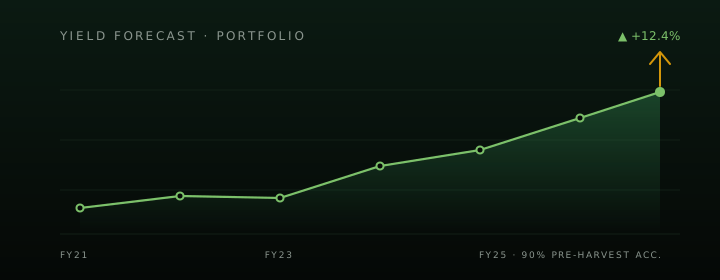
Modern farm operations now generate large volumes of field data, and investors are responding to this shift. As farms capture more field data, investors have started using precision farming tools to understand performance without relying on rough estimates.
Many agribusinesses have started using digital systems that record soil readings, crop movement, input use, and weather patterns in a consistent way. The numbers offer a clearer view of how the operation is functioning. Many teams now look at precision agriculture technology simply because it gives them a steady data trail to work with.
The changing landscape of agribusiness investment
Investment behaviour in agriculture has moved quietly but steadily toward operations that can be monitored, measured, and predicted. Instead of backing farms that depend purely on manual routines, investors now look for systems that produce clear data trails. Many of them see precision agriculture tools as the simplest way to build that visibility. The interest is not in modernisation alone; it is shaped by market expectations around sustainability, traceability, and compliance.
A farm that can show how it uses its water, how the soil behaves across seasons, or how a crop responds to climate shifts stands out immediately. These signals make the business more investable because they reduce uncertainty, something investors have always tried to control.
What precision farming tools actually are
Precision farming is really just a way of checking what the field is doing in real time. Farms use precision farming tools to get basic signals about soil, crop growth, or weather without walking every acre. Sometimes it comes from a sensor in the ground, sometimes from a quick drone pass or a satellite image.
These tools help farmers notice changes earlier and avoid using more inputs than the crop needs. It also supports sustainable farming because water, fertiliser, and labour are used more carefully. The idea is simple: understand the field better and act before problems grow.
Key drivers behind investor interest
1. Rising need for sustainable agriculture
Investors are choosing farms that show they can grow crops without exhausting their soil or water. Tools that guide input use help farms avoid over watering, unnecessary sprays, or excess fertiliser, which makes the whole operation cleaner and easier to justify in the long run.
2. Data backed decisions
Real time field data has changed how farms plan. When a team can see soil behaviour or early crop stress on their dashboard, decisions stop being guesswork. Many investors now look for farms that already rely on precision agriculture tools, because the numbers make the operation easier to understand and evaluate.
3. Better use of time and money
Farms using yield prediction software often run with fewer repeated tasks. Remote checks replace some in field labour, and inputs are used more carefully. For large farms, this often translates into steadier costs and smoother scaling.
4. Higher expectations from the market
Buyers have become more curious about how their food is grown. Farms using precision agriculture tools already keep small day to day records, so it is easier for them to answer those questions without extra work. Investors notice this and see it as a practical advantage.
A farm that can show how it uses its water and how a crop responds to climate shifts stands out immediately. It reduces uncertainty, and uncertainty is exactly what investors try to control.
How precision farming tools deliver measurable value
- Farms catch crop stress or disease earlier and can act before it spreads.
- Water, fertiliser, and sprays are applied more carefully, reducing waste.
- Yields become steadier because decisions follow real field conditions.
- Over time, these patterns support stronger margins and healthier land.
Where investors see strongest growth potential
- Bigger farms using simple IoT setups to keep an eye on fields without sending people out every time.
- Remote viewing tools that help managers check distant plots without waiting for field reports.
- Basic tools that read soil or crop behaviour on their own.
- Forecasting systems that give a rough idea of yield early in the season, so planning is easier.
Challenges investors consider
- The first setup can be expensive, so not every farm jumps in right away.
- Farmers require time to adjust to new tools, which can temporarily cause delays.
- Some areas still have weak network coverage, so data does not always update smoothly.
- New technology does not always fit neatly into the way a farm already works.
Agribusinesses are moving toward farm models that offer clearer data and steadier performance. Precision agriculture tools help farms use resources better while keeping yields predictable, and precision methods are set to guide how modern agribusiness grows in the coming years.